
US Steel Producer Comparison Tool
Select a company to view detailed production statistics and compare against industry leaders.
Nucor Corporation
EAF TechnologyLargest US Producer
U.S. Steel
Integrated & EAFOwned by Nippon Steel
ArcelorMittal USA
Integrated & EAFAutomotive Focus
Cleveland-Cliffs
Integrated & Mini-MillGreen Steel Pioneer
Select a Company
Key Statistics
| Annual Capacity: | - |
| Primary Technology: | - |
| Key Products: | - |
| Ownership: | - |
Capacity Comparison (Million Tons)
When you look at the skyline of a major American city or think about the frame of your car, you are looking at steel. But who actually makes it? The question "who is the largest steel mill in the US" doesn't have a simple one-word answer because the industry has shifted from massive integrated plants to a network of highly efficient mini-mills. Today, the title of the largest producer belongs to Nucor Corporation, but the landscape is complex, involving giants like U.S. Steel and Nippon Steel.
To understand who really dominates the market, we need to look beyond just square footage. We need to talk about annual production volume, technological efficiency, and the recent seismic shifts in corporate ownership. This guide breaks down the top players, their capacities, and what this means for the future of American manufacturing.
The Current King: Nucor Corporation
As of 2025, Nucor produces approximately 22 million tons of steel annually. They don’t rely on one single "mill" in the traditional sense. Instead, they operate a decentralized network of over 30 steel casting and rolling facilities across 22 states. This strategy allows them to be closer to their customers, reducing shipping costs and increasing responsiveness. Their flagship facility in South Carolina and their massive operations in Texas and Indiana serve as the backbone of this distributed model.
Why does Nucor hold the top spot? It’s not just size; it’s agility. While older competitors struggled with high labor costs and outdated infrastructure during the early 2000s, Nucor invested heavily in automation and employee profit-sharing. This culture kept them lean and profitable even when global steel prices fluctuated wildly.
The Historic Giant: U.S. Steel and the Nippon Deal
If Nucor is the agile modern champion, U.S. Steel is the historic symbol of American industrial might. For decades, U.S. Steel held the crown for the largest producer. They specialize in "flat-rolled" steel, which is essential for automotive bodies, appliances, and construction beams. Their Gary Works plant in Indiana is one of the most famous integrated mills in the world, capable of producing steel from raw iron ore.
However, the landscape changed dramatically in late 2024 when Japan’s Nippon Steel completed its acquisition of U.S. Steel. This deal was contentious, facing scrutiny from Congress and unions concerned about national security and job losses. Despite the hurdles, the merger proceeded, creating a transnational giant. Now, U.S. Steel operates under new ownership but retains its brand and many of its domestic facilities. In terms of pure tonnage, the combined entity challenges Nucor, but operational control and strategic direction now involve Japanese engineering principles mixed with American scale.
This shift raises questions about data reporting. Will U.S. Steel’s output be counted separately or merged into Nippon’s global totals? For now, in domestic rankings, U.S. Steel remains the second-largest independent producer by volume, though the gap between it and Nucor continues to widen due to Nucor’s aggressive expansion in EAF capacity.
The European Powerhouse: ArcelorMittal USA
Third on the list is ArcelorMittal USA, the American arm of the world’s largest steelmaker. Headquartered in Luxembourg, ArcelorMittal owns several key assets in the U.S., including the massive Gary Works facility (which they previously operated before selling interests) and significant plants in Minnesota and Ohio. They focus heavily on high-value products like automotive sheet metal and deep-drawn stampings.
ArcelorMittal brings a different dynamic to the table. Because they are part of a global conglomerate, they can source materials and sell products internationally more easily than purely domestic firms. However, they also face higher overhead costs associated with global management structures. Their U.S. operations contribute roughly 8-10 million tons to their global total, making them a critical player in the automotive supply chain, particularly for truck manufacturers in the Midwest.
Comparison of Top US Steel Producers
| Company | Primary Technology | Annual Capacity (Million Tons) | Key Product Focus | Ownership Structure |
|---|---|---|---|---|
| Nucor Corporation | Electric Arc Furnace (EAF) | ~22.0 | Rebar, Beam, Sheet Piling | Publicly Traded (US) |
| U.S. Steel | Integrated Blast Furnace & EAF | ~16.5 | Automotive Sheet, Plate | Subsidiary of Nippon Steel |
| ArcelorMittal USA | Integrated & EAF | ~9.0 | Deep Draw Steel, Automotive | Subsidiary of ArcelorMittal SA |
| Cleveland-Cliffs | Integrated & Mini-Mill | ~14.0 | Hot-Band, Cold-Rolled | Publicly Traded (US) |
Note that Cleveland-Cliffs often rivals ArcelorMittal for the third spot depending on whether you measure by shipped volume or nameplate capacity. Cliffs has been aggressively expanding its direct reduced iron (DRI) capabilities, aiming to produce green steel using hydrogen instead of coal. This positions them as a potential disruptor in the coming decade.
Technology Shifts: Why Size Isn't Everything
The definition of a "large mill" has evolved. In the 20th century, size meant height-massive blast furnaces towering over towns. Today, size means throughput and efficiency. The rise of the Electric Arc Furnace (EAF) has democratized steelmaking. You no longer need a billion-dollar integrated plant to compete. A well-run mini-mill can produce high-quality steel for a fraction of the cost.
This technological shift explains why Nucor leads. They adopted EAF early. Meanwhile, companies relying on older blast furnace technology faced higher energy costs and stricter environmental regulations. As the EU and California implement carbon border taxes, the ability to produce low-carbon steel becomes a competitive advantage. Nucor’s reliance on recycled scrap gives it a natural edge here, as recycling steel uses about 75% less energy than making it from virgin ore.
Regional Hubs of Production
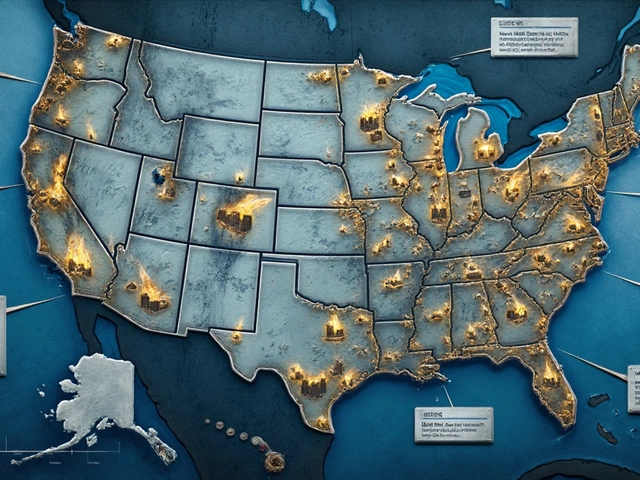
While Nucor is the national leader, specific regions dominate certain types of steel. The Midwest, particularly Indiana, Ohio, and Pennsylvania, remains the heartland of flat-rolled steel used in cars. The South, especially Alabama and Tennessee, has become a hub for long products like rebar and structural beams, driven by Nucor’s expansion. Texas hosts some of the newest, most technologically advanced mills, benefiting from cheap natural gas and proximity to Gulf Coast ports for export.
Understanding these regional strengths helps explain supply chain dynamics. If there is a shortage of automotive steel, the bottleneck is likely in the Midwest. If construction slows down, the impact is felt first in Southern mills. This geographic diversity strengthens the overall resilience of the U.S. steel industry against localized disruptions.
Future Outlook: Green Steel and Consolidation
Looking ahead to 2030, two trends will reshape the leaderboard. First, consolidation. The pressure to invest billions in decarbonization technologies may force smaller players to merge or exit. We may see fewer, larger entities controlling a greater share of the market. Second, the push for "green steel." Companies like SSAB in Sweden and Salzgitter in Germany are already producing hydrogen-based steel. U.S. producers must follow suit to remain competitive in global markets that increasingly demand low-carbon materials.
Nucor is investing in hydrogen injection for its furnaces. U.S. Steel, backed by Nippon’s capital, is exploring carbon capture utilization and storage (CCUS). The race isn't just about who can make the most steel, but who can make it cleanly. The largest steel mill of the future won't just be defined by tons per year, but by tons per ton of CO2 emitted.
Is Nucor still the largest steel producer in the US?
Yes, as of 2025, Nucor Corporation remains the largest steel producer in the United States by annual volume, producing approximately 22 million tons of steel. Their success is driven by their extensive network of electric arc furnace (EAF) mini-mills, which allow for efficient, decentralized production.
Who owns U.S. Steel now?
U.S. Steel is owned by Nippon Steel, a Japanese multinational corporation. The acquisition was completed in late 2024 after navigating regulatory approvals and political scrutiny. While the brand and many domestic operations remain, strategic decisions are now influenced by Nippon Steel's global objectives.
What is the difference between an integrated mill and a mini-mill?
An integrated mill uses blast furnaces to convert raw iron ore and coal into steel, requiring massive capital investment and large-scale operations. A mini-mill uses electric arc furnaces (EAF) to melt down recycled scrap steel, which is more flexible, cheaper to build, and generally more energy-efficient. Nucor pioneered the mini-mill approach.
Which state has the most steel mills?
Pennsylvania, Indiana, and Ohio traditionally host the highest concentration of steel production facilities, particularly integrated mills focused on automotive and construction steel. However, southern states like Alabama and Texas are seeing rapid growth in new EAF mill construction.
How does US steel production compare globally?
The United States is typically the third or fourth largest steel producer in the world, behind China and India. China produces over half of the world's steel. However, the U.S. maintains a strong position in high-value specialty steels and benefits from robust domestic demand in construction and automotive sectors.