
6M Root Cause Analyzer
Evaluate your production line's stability by assessing each of the six critical variables. This tool helps you pinpoint where deviations are most likely occurring.
and click Analyze.\n
Walk into any modern factory floor and you’ll likely hear the term 6M tossed around by engineers and quality managers. It’s not a machine model or a government scheme; it’s a fundamental diagnostic tool used to understand why processes fail or succeed. If you’ve ever wondered why a specific batch of products had defects while the next one was perfect, the 6M framework is how professionals trace that difference back to its source.
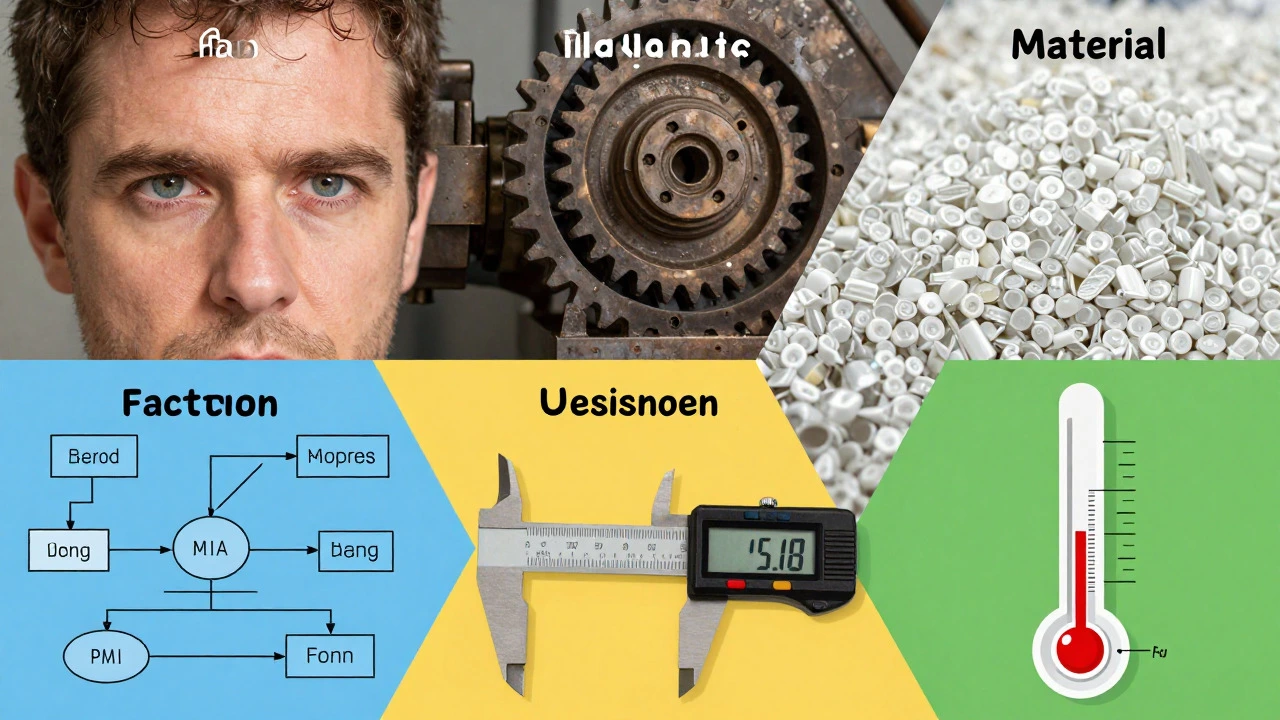
In simple terms, 6M stands for six key factors that influence production: Man, Machine, Material, Method, Measurement, and Mother Nature (Environment). By isolating these variables, manufacturers can pinpoint exactly where a process went wrong. This isn’t just theory-it’s the backbone of root cause analysis in industries ranging from automotive to pharmaceuticals.
The Core Components of the 6M Framework
To master this concept, you need to break down each 'M' individually. Each factor represents a distinct category of potential variation in your production line. Ignoring even one can lead to blind spots in your quality control strategy.
- Man: This refers to the human element. Are operators trained correctly? Is there fatigue? Does the team follow standard operating procedures? Human error is often the most overlooked but frequent cause of variability.
- Machine: Every piece of equipment has wear and tear. Is the CNC machine calibrated? Are the molds worn out? The condition of your hardware directly impacts product consistency.
- Material: Raw materials aren't always identical. Variations in supplier batches, humidity levels affecting wood or paper, or chemical purity in plastics all fall under this category.
- Method: This covers the process itself. Are the steps defined clearly? Is the sequence logical? If two different workers perform the same task differently, the method is likely ambiguous.
- Measurement: How do you know if the product is good? If your calipers are off by 0.1mm, your entire quality assessment is flawed. This M focuses on the accuracy and precision of your testing tools.
- Mother Nature (Environment): Temperature, humidity, dust, and vibration. In high-precision electronics manufacturing, a slight change in room temperature can alter resistance values. In food processing, humidity affects packaging integrity.
Why 6M Matters More Than You Think
You might ask, "Why not just fix the problem when it happens?" The issue is that symptoms don't always point to the true cause. A cracked part might look like a material defect, but it could actually be caused by a machine running at the wrong speed. The 6M framework forces you to look at the system holistically rather than jumping to conclusions.
This approach is critical for reducing waste. In lean manufacturing, waste (or *muda*) is the enemy. By systematically checking each of the six factors, you prevent rework, scrap, and customer complaints. It shifts the culture from blame-focused to system-focused. Instead of asking "Who messed up?", teams ask "Which of the six Ms contributed to this variance?"
Applying 6M in Real-World Scenarios
Let’s look at a concrete example. Imagine a bakery producing bread loaves. One morning, customers complain that the crust is too hard. Using the 6M lens, the manager investigates:
- Man: Did the new hire adjust the oven timer incorrectly?
- Machine: Is the oven thermostat stuck, causing it to run hotter than set?
- Material: Did the flour supplier switch to a higher-protein blend that requires less baking time?
- Method: Was the proofing time shortened due to staffing shortages?
- Measurement: Is the oven thermometer accurate?
- Environment: Is the kitchen unusually dry today, causing faster moisture loss?
Comparison: 4M vs. 5M vs. 6M
You may have heard of 4M or 5M frameworks. These are older or simplified versions. Understanding the differences helps you choose the right level of detail for your analysis.
| Framework | Components Included | Best Used For | Limitation |
|---|---|---|---|
| 4M | Man, Machine, Material, Method | Basic troubleshooting, small workshops | Ignores measurement errors and environmental factors |
| 5M | Adds Measurement to 4M | Quality control labs, precision assembly | Still overlooks external environmental impacts |
| 6M | Adds Environment (Mother Nature) | High-precision industries, outdoor-affected processes | Can be complex to track all variables simultaneously |
The 6M model is the most comprehensive because it acknowledges that factories don’t exist in a vacuum. Climate control failures, seasonal humidity changes, and even local power grid fluctuations (which affect motor speeds) are all part of the environment. For industries like semiconductor fabrication or pharmaceutical compounding, ignoring the 'E' (Environment) can be catastrophic.
Common Pitfalls When Using 6M
Even with a solid framework, teams make mistakes. Here are the most common ones to avoid:
- Tunnel Vision: Focusing only on 'Man' because it’s the easiest to observe. Humans are visible; machine calibration drift is not. Always check the invisible factors first.
- Poor Data Logging: If you don’t record environmental conditions or machine settings during production, you can’t correlate them with defects later. Invest in automated data collection.
- Overcomplicating: Not every defect involves all six Ms. Sometimes it’s just one. Use the framework as a checklist, not a rigid formula. Start with the most likely suspects based on historical data.
- Lack of Standardization: If 'Method' varies between shifts, your baseline for comparison is broken. Ensure SOPs (Standard Operating Procedures) are strict and audited.
How to Implement 6M in Your Facility
Integrating 6M doesn’t require expensive software, but it does require discipline. Start by creating a simple 6M checklist for your critical processes. Train your floor supervisors to use it during daily huddles.
- Identify Critical Processes: Pick the top three processes that impact quality or cost the most.
- Define Baselines: Document the ideal state for each of the six Ms. What is the correct temperature? What is the approved material spec? What is the calibrated range for your gauges?
- Monitor Deviations: Set alerts for when parameters drift outside the baseline. For example, if humidity exceeds 60%, trigger an alert for packaging lines.
- Review Weekly: Hold a weekly review of defect logs. Map each defect to one or more of the 6Ms. Look for patterns. Are most issues related to Machine? Then schedule preventive maintenance. Are they related to Man? Then invest in training.
Remember, the goal isn’t perfection. It’s predictability. When you understand how each of the six factors influences your output, you stop reacting to problems and start preventing them. That’s the real power of the 6M framework.
Is 6M the same as 5S in manufacturing?
No, they are different. 5S is a workplace organization method (Sort, Set in order, Shine, Standardize, Sustain) focused on cleanliness and efficiency. 6M is a root cause analysis tool focused on identifying sources of variation in product quality. They complement each other but serve different purposes.
Which of the 6Ms is most commonly the cause of defects?
It varies by industry, but 'Man' (human error) and 'Machine' (wear and tear) are statistically the most frequent causes in general manufacturing. However, in high-precision environments, 'Environment' and 'Measurement' often play a larger role.
Do I need special software to implement 6M?
No. You can start with paper checklists or spreadsheets. As your data volume grows, you might integrate 6M tracking into your MES (Manufacturing Execution System) or QMS (Quality Management System) software for better automation and reporting.
How is 6M used in Six Sigma projects?
In Six Sigma, 6M is often used during the 'Analyze' phase of the DMAIC (Define, Measure, Analyze, Improve, Control) methodology. It helps teams brainstorm potential causes of a problem before testing hypotheses with statistical tools.
Can 6M be applied to service industries?
Yes, though less common. For example, in logistics, 'Man' could be driver behavior, 'Machine' could be truck reliability, 'Material' could be cargo packaging, 'Method' could be route planning, 'Measurement' could be delivery time tracking, and 'Environment' could be weather conditions. The logic remains the same.