
US Manufacturing Location Cost Estimator
Compare the estimated annual overhead and labor costs for a small-scale manufacturing operation across top low-cost US states. Adjust your facility size and team size to see how total costs change.
- Rent: Midpoint of state range
- Labor: 2,080 hours/year per employee
- Wage: Midpoint of state range
| State | Rent ($/sq ft) | Wage ($/hr) | Tax Status | Estimated Annual Total |
|---|
Cost Breakdown Visualization
Selected State: -
Logistics Advantage: -
Most founders assume that building a product in the United States is automatically expensive. They look at California or New York and see high rent, high wages, and high taxes. But the map of American manufacturing is not uniform. In fact, some states offer a combination of low industrial real estate, moderate labor costs, and favorable tax environments that make them significantly cheaper than their coastal counterparts. If you are launching a manufacturing startup, knowing where to set up shop can save you tens of thousands of dollars in your first year alone.
The cost of manufacturing isn't just about what you pay workers. It’s a complex mix of fixed and variable expenses. To find the cheapest place, you need to break down these costs into three main buckets: facility overhead, labor, and logistics. Ignoring any one of these will lead to a surprise on your P&L statement later.
Breaking Down the True Cost of Production
Before looking at specific states, let's define what actually drives your monthly burn rate. The biggest hidden cost for new manufacturers is usually overhead. This includes rent, utilities, insurance, and property taxes. In many Southern and Midwestern states, industrial square footage costs 30-50% less than in the Northeast or West Coast. For example, renting 10,000 square feet in a prime industrial zone in Georgia might cost $6 per square foot annually, while the same space in New Jersey could easily hit $15 or more.
Labor is the second major factor. While minimum wage varies by state, the average hourly wage for production workers does too. However, lower wages don't always mean lower total labor costs if turnover is high. You have to factor in recruiting, training, and productivity losses. That’s why regions with established manufacturing cultures often win out despite slightly higher base wages-they have a ready-made workforce that doesn’t need extensive retraining.
Finally, there’s logistics. If your customers are in the East, shipping from Texas adds days and dollars to your delivery time. But if you’re selling nationally or exporting, being centrally located can offset higher local costs. Freight rates fluctuate, but generally, moving goods across state lines adds 10-20% to your final unit cost compared to intra-state distribution.
The Top Low-Cost Regions for Manufacturing
Based on current industrial real estate data and labor market trends, a few states consistently rank as the most affordable places to manufacture in the US. These aren't necessarily the "best" places for every industry, but they offer the lowest baseline entry costs.
- Georgia: Known for its automotive and aerospace supply chains, Georgia offers a balanced mix of skilled labor and low overhead. The absence of a state income tax makes it attractive for corporate structuring, though local sales taxes still apply. Cities like Atlanta and Savannah provide excellent port access for imports and exports.
- Tennessee: With no state income tax and relatively low property taxes, Tennessee has become a hub for light manufacturing. The Memphis region, in particular, benefits from FedEx’s global logistics network, making it ideal for companies that ship finished goods quickly.
- North Carolina: The Research Triangle area offers a deep pool of engineering talent, which is crucial for tech-heavy manufacturing. While salaries are higher than in rural areas, the proximity to both East and West Coast markets reduces long-haul shipping costs significantly.
- Ohio: As a traditional industrial heartland, Ohio has a massive infrastructure for heavy manufacturing. Industrial land prices are among the lowest in the country, and the workforce is experienced in steel, machinery, and auto parts production.
- Mississippi: For pure cost-cutting, Mississippi often takes the crown. Labor costs are the lowest in the nation, and state incentives for job creation are aggressive. However, the smaller talent pool means you may need to invest more in training or relocate key staff from other states.
Comparing Key Cost Factors Across States
To make this concrete, let’s compare a few top contenders using average annual costs for a small-scale operation (approx. 5,000 sq ft facility, 10 employees). These figures are estimates based on 2025-2026 market averages and should be validated with local brokers before signing a lease.
| State | Avg. Industrial Rent ($/sq ft) | Avg. Hourly Wage (Production) | State Income Tax | Logistics Advantage |
|---|---|---|---|---|
| Georgia | $8 - $12 | $18 - $22 | No State Tax | Port of Savannah / Hartsfield-Jackson |
| Tennessee | $7 - $11 | $17 - $21 | No State Tax | FedEx Hub / I-40 Corridor |
| North Carolina | $9 - $13 | $19 - $24 | Yes (~5%) | Central US Location |
| Ohio | $6 - $10 | $18 - $23 | Yes (~3-4%) | Rail & Highway Intersections |
| Mississippi | $5 - $9 | $15 - $19 | Yes (~5%) | Gulf Coast Access |
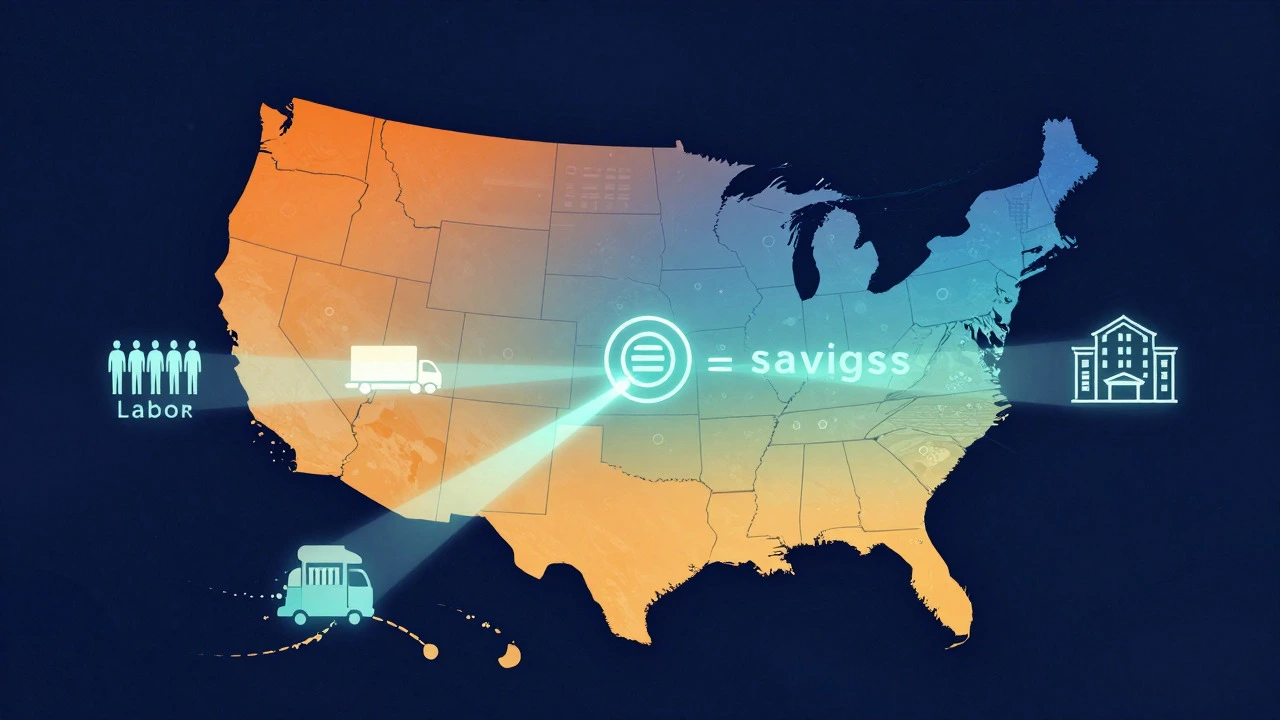
Notice how Mississippi wins on raw numbers but lacks the logistical density of Georgia or Tennessee. If your product is lightweight and ships via air freight, location matters less. If it’s heavy and moves by truck or rail, Ohio or Georgia might be the smarter play despite slightly higher wages.
Hidden Costs That Can Wipe Out Savings
It’s easy to get excited about low rent in a rural part of Alabama or South Dakota. But there are pitfalls that catch new founders off guard. The biggest one is the "talent gap." If you’re in a remote area, finding qualified machine operators or quality control managers can take months. You might end up paying relocation bonuses or flying in consultants, which erodes your initial savings.
Another hidden cost is utility variability. Some older industrial buildings in the Midwest have outdated HVAC systems that consume massive amounts of energy. Before signing a lease, request five years of utility bills. A cheap building with inefficient infrastructure can cost more in electricity than a modern, green-certified facility in a pricier city.
Also, consider local permitting fees. Some counties have streamlined processes for manufacturing permits, while others require environmental impact studies that can add six months to your timeline. Time is money. Delaying your launch by three months because of red tape in a "cheap" location can cost more than the extra $2 per square foot you’d have paid elsewhere.
How to Choose Your Specific Location
Choosing the right state is step one. Step two is picking the right city or county within that state. Here’s a simple framework to use:
- Map your supply chain: Where do your raw materials come from? If you import components from Asia, prioritize states with major ports (Georgia, North Carolina, Texas). If you source domestically, look near interstate highways or rail hubs.
- Assess your talent needs: Do you need highly skilled engineers, or general assembly line workers? For engineers, target metro areas with universities (e.g., Raleigh, NC; Columbus, OH). For assembly, rural areas with existing manufacturing bases work well.
- Check local incentives: Many states offer tax abatements for creating jobs. In some cases, you can negotiate a 10-year property tax exemption. Talk to the local economic development office early-they want your business.
- Visit the site: Never sign a lease without visiting. Walk the floor. Check the ceiling height (crucial for racking), the condition of the electrical panel, and the loading dock capacity. Photos lie; your eyes don’t.
Common Mistakes to Avoid
Don’t chase the absolute lowest price. A 5% reduction in labor costs won’t matter if your logistics costs double because you’re too far from your customers. Aim for the best *total* cost of ownership, not the lowest sticker price.
Also, avoid over-leasing. Start smaller than you think you need. It’s easier to expand into adjacent space than to sublease unused square footage. Many successful startups begin in a 2,000-square-foot unit and grow organically as demand increases.
Finally, build relationships with local suppliers. In smaller towns, word travels fast. If you treat your local vendors well, they’ll often extend better payment terms or priority service, which improves your cash flow significantly.
Frequently Asked Questions
Is it cheaper to manufacture in the US or overseas?
For low-volume, high-value, or custom products, US manufacturing is often competitive when you factor in shipping, tariffs, and quality control. For mass-produced, commodity items, overseas may still be cheaper due to scale economies. The trend is shifting toward "nearshoring" and domestic production for speed and reliability.
Which state has the lowest minimum wage for manufacturing workers?
As of 2026, several states including Mississippi, Alabama, and Louisiana have minimum wages tied to the federal level of $7.25/hour. However, actual market wages for skilled manufacturing roles are typically higher, ranging from $15 to $25 depending on the role and region.
Do state incentives really help small businesses?
Yes, but they vary. Large corporations get the headline-grabbing deals, but most states have programs for small businesses too, such as property tax abatement, training grants, or R&D credits. You must apply proactively; these incentives are rarely given automatically.
What is the most important factor in choosing a manufacturing location?
Proximity to your customer base is often the most critical factor. Shipping costs and lead times directly impact your ability to compete. A slightly more expensive location that cuts your delivery time by two days can be worth the premium.
Can I start manufacturing in a shared workspace?
Absolutely. Many startups begin in maker spaces, co-working facilities, or leased bays in larger factories. This reduces upfront capital expenditure significantly. Just ensure the space meets your specific safety and zoning requirements for your type of production.