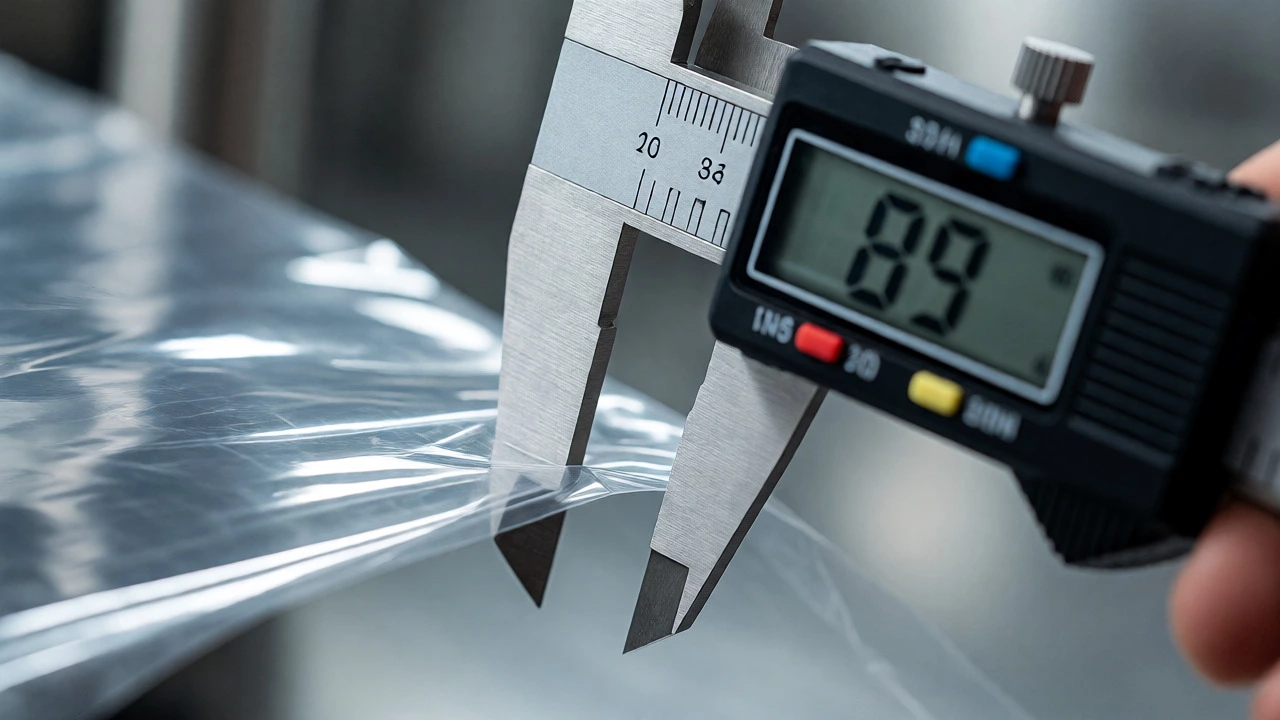

Thou & Mil Precision Converter
Enter a value in any unit below to see equivalent measurements in Inches, Thou (Mils), and Millimeters. Remember: 1 Thou = 0.001 Inch.
Equivalent Measurements
Enter a value above to calculate conversions.
You’re standing in a factory, watching a conveyor belt move delicate snack wrappers, or maybe you’re checking the thickness of a cheese slice at home. You need to measure something incredibly thin-so thin that standard rulers feel useless. You look at your caliper or micrometer and see 0.1 inch. But if you ask a machinist what that is, they won’t say "zero point one." They’ll call it a "thou" or a "mil." Why does this unit exist? And why should anyone working in food processing care about a unit named after a thousandth?
This isn’t just trivia for engineers. In industries where packaging integrity determines shelf life, or where dough consistency affects texture, knowing these tiny units saves money and product. Let’s break down exactly what 0.1 inch is called, how it fits into the imperial system, and why it matters when you’re dealing with everything from aluminum foil to sausage casings.
The Name Game: Thou vs. Mil
First, let’s clear up the confusion. When someone asks, "What is 0.1 inch called?", they are usually asking about the subdivision of an inch, not 0.1 itself (which is 1/10th). The term for one-thousandth of an inch is a thou, which is a unit of length equal to one-thousandth of an inch (0.001 in). It is also widely known as a mil, though this term causes headaches because "mil" can also mean a millimeter in some contexts, or a military installation in others.
In the UK, where I’m based in Birmingham, we tend to stick with "thou" to avoid mixing up our measurements with metric millimeters. In the US, "mil" is more common in manufacturing circles. If you’re reading specs for plastic wrap or metal cans, you’ll likely see "mils." If you’re talking to a toolmaker, they might say "thou." Both refer to the same thing: 0.001 inches.
So, if you have a measurement of 0.1 inches, that is actually 100 thou. That’s a significant difference! A common mistake is thinking 0.1 inch equals one thou. It doesn’t. One thou is 0.001 inch. Therefore:
- 1 thou = 0.001 inch
- 10 thou = 0.01 inch
- 100 thou = 0.1 inch
Understanding this scale is critical. If you order packaging film that is "1 mil" thick, you are getting a sheet that is 0.001 inches thick. If you thought you were ordering 0.1 inches (which is nearly a quarter of a centimeter), you’d be shocked by how thin the material actually is.
Why Do We Need Such Small Units?
Imagine trying to bake bread without being able to measure yeast precisely. You’d use spoons, but professional bakers use grams. Similarly, in industrial settings, using fractions like 1/64th of an inch becomes messy when you need higher precision. Fractions get unwieldy fast. Who wants to calculate 37/128ths of an inch on the fly?
Decimals help, but even decimals like 0.0015 inches are hard to visualize. Enter the thou. It turns a decimal into a whole number. Instead of saying "0.0035 inches," a machinist says "three and a half thou." It’s faster, clearer, and less prone to mishearing over noisy factory floors.
| Imperial Fraction | Decimal Inches | Thou (Mils) | Metric Equivalent (mm) |
|---|---|---|---|
| 1/8" | 0.125" | 125 | 3.175 mm |
| 1/16" | 0.0625" | 62.5 | 1.5875 mm |
| 1/32" | 0.03125" | 31.25 | 0.79375 mm |
| 1/64" | 0.015625" | 15.625 | 0.396875 mm |
| 1/128" | 0.0078125" | 7.8125 | 0.1984375 mm |
| 1/1000" | 0.001" | 1 | 0.0254 mm |
Food Processing Applications: Where Precision Meets Appetite
You might wonder, "I’m making jam, not building a jet engine. Why do I care about thouns?" Because modern food processing relies heavily on packaging materials and machinery tolerances that are measured in these tiny increments.
Packaging Film Thickness
Plastic films used for wrapping sandwiches, freezing vegetables, or sealing meat are often specified in mils. For example, cling film might be 100-200 gauge (which is another way of saying 1-2 mils, or 0.001-0.002 inches). If the film is too thin, it tears during automated packing lines. Too thick, and you’re wasting money and creating excess waste.
When you buy "heavy-duty" freezer bags, you’re paying for higher gauge numbers, meaning thicker plastic measured in thou/mils. Knowing this helps you compare products objectively rather than relying on marketing terms.
Casings and Coatings
Sausage casings, both natural and collagen, vary in thickness. Natural hog casings might range from 30 to 40 thou (0.030-0.040 inches). Collagen casings can be thinner, around 15-20 thou. If you’re producing sausages commercially, the casing thickness affects how much filling you can pump per meter and how the sausage snaps when bitten. Getting this wrong leads to burst casings or tough bites.
Similarly, chocolate coatings or candy shells have precise thickness requirements. A shell that is 50 thou thick will crack differently than one that is 30 thou. Manufacturers use calipers calibrated in thou to ensure every M&M or Smartie has the right crunch.
Equipment Maintenance
Food processing machinery, like slicers or dicers, has blades and gaps that wear over time. A gap of 10 thou might seem negligible, but if you’re slicing ham to a specific thickness, that 10 thou drift means every slice is off-spec. Technicians use feeler gauges labeled in thou to adjust these gaps quickly.
Historical Context: From Barleycorns to Thouns
The imperial system is old, and its units reflect ancient agriculture. An inch was originally defined as three barleycorns placed end-to-end. As industry advanced, those agricultural roots became inadequate for machine parts. The thou emerged in the late 19th and early 20th centuries alongside precision machining tools like micrometers.
Before digital displays, machinists read vernier scales and micrometer barrels marked in tenths of a thousandth. Calling it a "thou" made verbal communication easier. "Check that shaft, it’s two thou out of round" is quicker than "Check that shaft, it’s zero-point-zero-zero-two-inches out of round."
While the metric system uses millimeters and microns (one-millionth of a meter) for similar purposes, the thou remains stubbornly alive in countries that haven’t fully converted, particularly in specialized sectors like aerospace, automotive, and yes, certain areas of food equipment maintenance.
Common Pitfalls and How to Avoid Them
Confusing thou with millimeters is the biggest error. Remember: 1 thou = 0.0254 mm. So, 1 mm is roughly 39.37 thou. If you assume 1 thou is 1 mm, you’re off by a factor of 40. That’s enough to ruin a batch of cookies if you’re measuring dough thickness manually.
Another trap is confusing "gauge" with "thou." In wire and sheet metal, gauge numbers work inversely: higher gauge means thinner material. For plastics, however, "gauge" often directly correlates to thickness in hundredths of a millimeter or sometimes mils, depending on the region and manufacturer. Always check the spec sheet. Don’t guess.
Finally, don’t ignore rounding errors. In high-volume production, accumulating a 0.5 thou error across thousands of units adds up. Regular calibration of your measuring tools ensures you aren’t drifting off-spec silently.

Practical Tips for Non-Engineers
If you’re running a small bakery or a boutique food brand, you probably don’t need a micrometer. But understanding these units helps when buying supplies or troubleshooting.
- Read Packaging Specs: Look for "micron" (metric) or "mil/gauge" (imperial). Convert them mentally: 1 mil ≈ 25 microns. If a bag says "100 micron," that’s about 4 mils (0.004 inches).
- Use Digital Calipers: They’re cheap now. Set them to display in thou or mm depending on your comfort level. Most allow easy switching.
- Standardize Within Your Team: Pick one unit system and stick to it. Mixed units cause mistakes. If everyone thinks in thou, keep it that way. If you’re metric, stay metric.
Frequently Asked Questions
Is 0.1 inch the same as 1 thou?
No. 1 thou is 0.001 inch. Therefore, 0.1 inch is equal to 100 thou. This is a common misunderstanding; always double-check your decimal places.
Why is it called a "thou"?
The name comes from "thousandth," referring to one-thousandth of an inch. It’s a colloquial shortening used by machinists for speed and clarity.
Can I use thou in food safety regulations?
Regulations typically specify limits in metric units (millimeters or microns) globally, including in the EU and increasingly in the US. However, equipment manuals and supplier specs may still use thou/mils. Always convert to the regulatory standard for compliance checks.
How many thou are in a millimeter?
There are approximately 39.37 thou in one millimeter. Conversely, one thou is exactly 0.0254 millimeters.
Do chefs use thou measurements?
Most chefs use millimeters or inches. However, pastry chefs working with laminated doughs or chocolate tempering might reference thickness in thou when dealing with industrial equipment specs or specialty molds.